
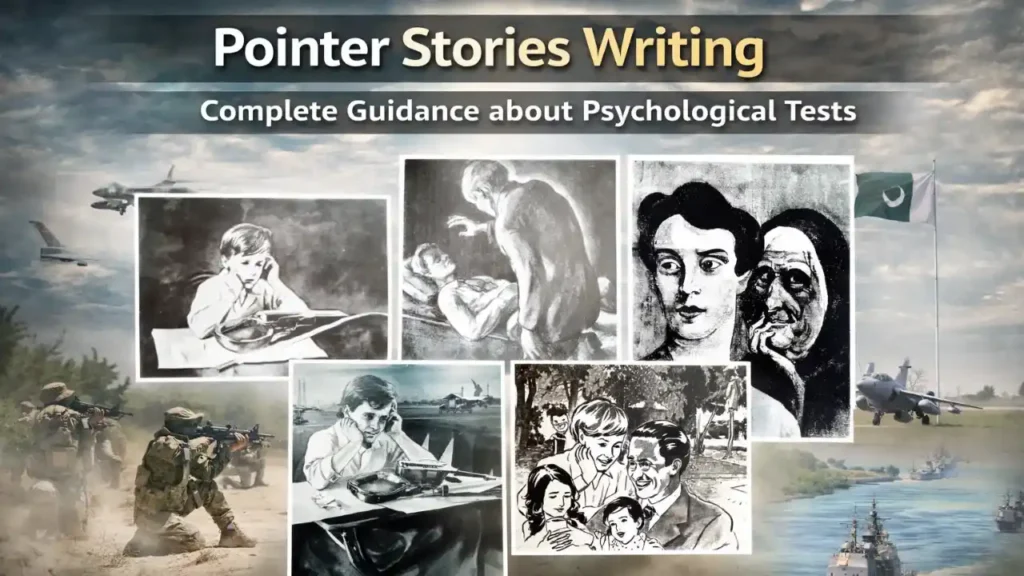
Write Pointer Stories In Issb | Complete Guidance And Tips
Master the art of **ISSB Pointer Story writing** with our expert-led preparation guide. Pointer stories are a critical component of the psychological assessment, designed to evaluate your imagination, mental stability, and decision-making speed.
The Role Of Branch Officers In Force Assessment
In the ISSB, psychologists and branch officers analyze your narratives to identify leadership potential and social maturity. Your ability to maintain logical consistency under time pressure is a direct indicator of how you would perform as a commissioned officer in the Army, Navy, or PAF.
Strategy: The 4-Minute Challenge
- 0:00 - 0:30: Strategic thinking and plot formulation.
- 0:30 - 4:00: Execution of a complete, coherent narrative.
Pro Tip: Success depends on connecting the incomplete line to a proactive, goal-oriented outcome that reflects your officer-like qualities.
Mastering Pointer Stories In ISSB
Pointer stories are a vital psychological test. Use this structured guide to refine your ability to draft concise, logical, and proactive narratives within the strict 4-minute time limit.
Assessment Goal
Assess personality traits, mental stability, and decision-making speed.
Time Management
30 Seconds: Plan your plot.
3.5 Minutes: Execute your story.
Download Comprehensive Pointer Stories Guide
📄 Download PDF GuideAdvance Pointer Stories Practice Vol 2
Continue your preparation with Volume 2 of our Pointer Stories series. This guide contains advanced scenarios designed to test your mental agility and decision-making capabilities during the ISSB psychological evaluation.
Download Pointer Stories Guide Volume 2
📥 Access Pointer Stories PDFExpert ISSB Test Preparation And Online Coaching
Achieve your dream of becoming an officer with personalized coaching from retired forces experts and comprehensive personality assessments.
Comprehensive ISSB Preparation Resources
Complete Preparation Resources For Pakistan Military Forces Initial Tests
Prepare for your PAF, Army, and Navy initial tests with our extensive collection of expert-curated materials. Access free past papers, PDF study guides, video lectures, and interactive practice tools to ensure your success.
Pakistan Military Ranks, Salary And Career Paths
Join Pakistan Military Forces
Discover the latest career opportunities. Stay updated with current job openings and recruitment schedules for the Army, Navy, and Air Force.
Selection Centers Of Army, Navy & PAF
Join Our Official Community
Stay updated with the latest military exam notifications, expert preparation tips, and real-time study alerts. Click below to join our growing network of dedicated candidates.
Frequently Asked Questions: Writing Pointer Story In ISSB
The Pointer Story test assesses your imagination, mental stability, and ability to construct a logical narrative under strict time constraints, which reflects your officer-like qualities.
You are given 30 seconds to analyze the incomplete line and 3 minutes and 30 seconds to write your complete story, totaling 4 minutes per task.
Stories should be grounded in reality. Assessors look for practical solutions to challenges that demonstrate leadership, initiative, and social adjustment.
Focus on a clear objective. Ensure the transition from the provided pointer to your story is seamless and moves toward a successful, constructive outcome.
It is best to avoid negative or hopeless endings. Your story should depict a proactive protagonist who solves problems effectively and maintains a positive attitude.
There is no strict word count, but you should aim for 150-200 words to ensure your story is detailed yet concise enough to finish within the 3.5-minute limit.
Psychologists look for maturity, decisiveness, originality, empathy, and the ability to work well with others to achieve a common goal.
Practice by randomly picking incomplete sentences and timing yourself. Focus on identifying the core problem and writing a solution-oriented conclusion.
Not necessarily heroic, but it must be responsible. Your character should display duty, integrity, and sound judgment in everyday situations.
Content is the priority, but clear handwriting and correct grammar ensure your message is communicated without ambiguity, reflecting your attention to detail.


