
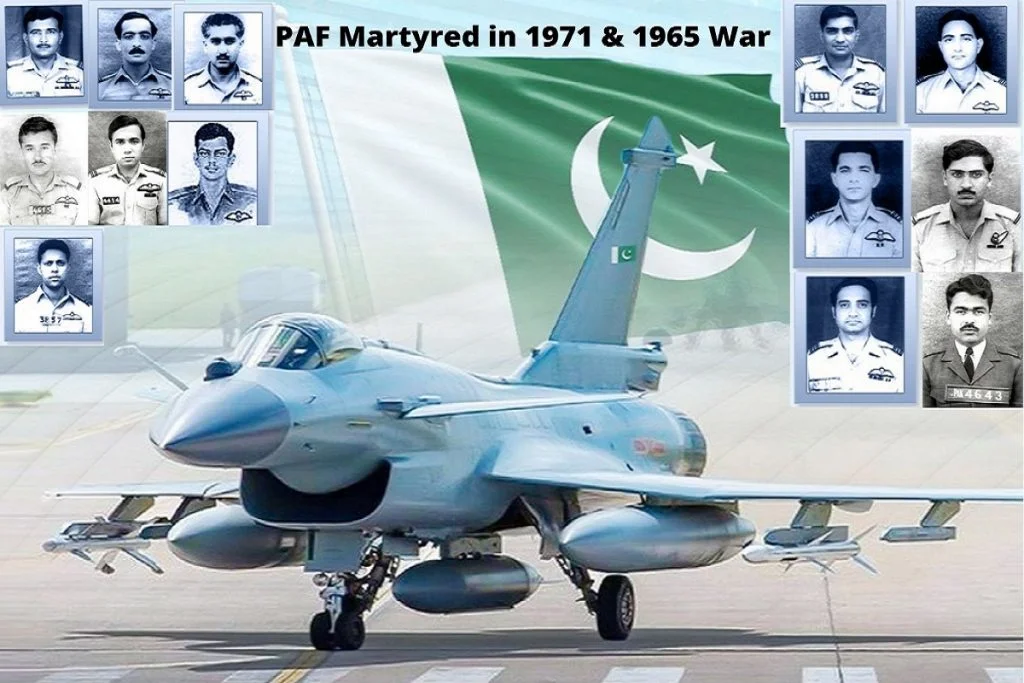
PAF Martyred of 1965 & 1971 War
The Pakistan Air Force (PAF) has a proud history of courage and sacrifice, especially during the 1965 and 1971 wars. Many brave PAF martyred heroes gave their lives defending Pakistan’s sovereignty and integrity. The PAF’s role in these wars was pivotal, with officers and airmen exhibiting unmatched valor. During the 1965 war, PAF pilots engaged in fierce air combat, while in 1971, they continued their legacy of sacrifice.
The martyrs of the PAF are a source of national pride, remembered for their dedication to duty and the defense of the motherland. Their heroic contributions are commemorated in various PAF memorials and aircraft displays, serving as a reminder of their ultimate sacrifice for Pakistan’s security and freedom. The stories of these PAF martyred heroes continue to inspire future generations to serve and protect the nation.
Pakistan Air Force was established by British Government in 1933, Near Drigh Road, Karachi which is currently called PAF Base Faisal. In 1933, operation of Air Force was extended to the KPK (Old name was North West Frontier Province) with the name of Royal Air Force who also took part in the World War-II where number of PAF martyred sacrificed their lives.
In Pakistan Air Force, our Heroes sacrificed their lives for this Pak Land and defended bravely. Currently, the famous Lady Pilot Martyred, Marium Mukhtiar, a fighter pilot, died by flying through FT-7PG aircraft near Kundian district, Mianwali on 24 Nov, 2015. She was honored as the first lady pilot of the Pakistan Air Force who embraced Shahadat. She was awarded with Tamgha-e-Basalat.
Must see below:
| 1. | Join Pak Army as an Army Officer | Click Here |
| 2. | Join Pakistan Navy as a Navy Officer | Click Here |
| 3. | Join PAF as a PAF Officer | Click Here |
In the following, names, rank and detail of the PAF Pilots who got Shahadat in 1965 & 1971 War.
LIST OF PAF MARTYRED

Squadron Leader Sarfaraz Ahmad Rafiqui
Pak No: 1429
Born: July 18, 1935
Died : September 6, 1965
Awards : Hilal-e-Jurat and Sitara-e-Jurat
On September 6, 1965, Squadron Leader Sarfaraz Ahmad Rafiqui led a formation of three.
F-86 aircraft on strike against Halwara airfield. The formation was intercepted by about 10 Hunter aircraft, out of which Squadron Leader Rafiqui accounted for one in the first few seconds. But then his guns jammed due to a defect and stopped firing.
However, Rafiqui refused to leave the battle area, which he would have been perfectly justified to do; instead, he ordered his No. 2 to take over as leader and continue the engagement while trying to give the formation as much protection as was possible with an unarmed aircraft. This was called on the part of Squadron Leader Rafiqui.
The end for him was never in doubt, but he chose to disregard it. His aircraft was shot down in the process, and he was killed but not before enabling his formation to shoot down three more Hunter aircraft.
Rafiqui’s conduct was clearly beyond the call of duty and conformed to the highest traditions of leadership and bravery in battle against overwhelming odds. For this and his earlier exploits, he (Martyred) is awarded Hilal-e-Jurat and Sitara-e-Jurat.

Squadron Leader Munir-ud-Din Ahmed
Pak No: 5030
Born: 1927
Died: September 10, 1965
Awards : Sitara-e-Jurat
During the war, a high-powered, heavily defended radar station near Amritsar was attacked repeatedly by the PAF fighters.
In all these missions, Squadron Leader Munir unhesitatingly volunteered to fly and, without regard for his safety, exposed himself to intense fire for long periods in an attempt to locate and destroy the target.
In the final successful attack on September 11, he made the supreme sacrifice when his aircraft was fatally hit. Before his last sortie, Munir flew eight combat missions and shot down an IAF Gnat on September 10.
For displaying courage and determination in the face of heavy odds and beyond the call of duty, Squadron Leader Munir-ud-Din Ahmed (Martyred) is awarded Sitara-e-Jurat.

Squadron Leader Allaudin Ahmad
Pak No: 5034
Born: October 3, 1930
Died: September 13, 1965
Awards : Sitara-e-Jurat
Squadron Leader Alauddin Ahmed led his squadron in twenty combat missions against the Indian ground and air forces.
His leadership throughout the operations was cool, courageous and determined, which inspired the greatest confidence amongst pilots of his formations and resulted in the destruction of many Indian tanks and vehicles.
In his last sortie, he attacked and blew up an important ammunition train at Gurdaspur rail-head in complete disregard for his personal safety.
During this attack on September 13, his aircraft was damaged, and he was reported missing over enemy territory. Subsequently, it was confirmed that the officer died in this action.
For his exemplary leadership, courage and bravery, Squadron Leader Alauddin Ahmed (Martyred) is awarded Sitara-e-Jurat.

Flight Lieutenant Younis Hussain
Pak No: 3857
Born: June 1, 1935
Missing since: June 9, 1965
Awards : Sitara-e-Jurat
Flight Lieutenant Yunus Hussain fought in air battles aggressively, fearlessly and with excellent professional skills.
He fought singly against six enemy aircraft and shot down 2 Hunters during one such engagement. Though his plane was damaged in this encounter, he managed to safely bring it back to base.
On September 6, while attacking Halwara airfield, his small formation was intercepted by a large number of the enemy.
Although his aircraft was hit, he refused to break off the engagement in complete disregard for personal safety and was reported missing from this mission.
He became a symbol of courage and professional ability for other pilots. For his gallantry, courage, professional skill and devotion to duty, he (Martyred) is awarded Sitara-e-Jurat.

Pilot Officer Rashid Minhas
Pak No: 5602
Born: February 17, 1951
Died: August 20, 1971
Awards: Nishan-e-Haider
On the morning of Friday, August 20, 1971, Pilot Officer Rashid Minhas (Martyred), a pilot still under training, was in the front seat of a jet trainer, taxing out for takeoff.
An instructor pilot from the same unit forced his way into the rear cockpit, seized control of the aircraft and having taken off, headed the plane towards India. With just some 40 miles of Pakistan territory remaining, Minhas had only one course open to him to prevent his plane from entering India.
Without hesitation and living up to the highest traditions of the Pakistan Air Force, Rashid Minhas tried to regain control of his aircraft, but finding this to be impossible in the face of the superior skill and experience of his instructor, forced the plane to crash at a point 32 miles from the Indian border.
In doing so, Pilot Officer Minhas deliberately made the supreme sacrifice for the honour of Pakistan and the service to which he belonged.
For this act of heroism above and beyond the call of duty, the President of Pakistan is pleased to award the Nishan-e-Haider to Pilot Officer Rashid Minhas (Martyred).

Squadron Leader Muhammad Iqbal
Pak No : 1431
Born : March 3, 1931
Died : September 11, 1965
Awards : Sitara-e-Jurat
Squadron Leader Muhammad Iqbal flew many operational missions, which played a vital part in the success of the Pakistan Air Force during the India-Pakistan War.
He carried out these missions with determination, enthusiasm, outstanding ability, and significant personal risk.
His performance throughout was exemplary and highly inspiring for the personnel under his command.
For his outstanding leadership, valour, loyalty and invaluable services to the Pakistan Air Force and the country, he (Martyred) is awarded Sitara-e-Jurat.
| 1. | Best general knowledge questions | Click Here |
| 2. | Top questions of Interview | Click Here |
| 3. | Frequently asked Questions of Interview | Click Here |
| 4. | Past Questions of Initial Tests | Click Here |
| 5. | Best Tips to pass Interview | Click Here |

Wing Commander Syed Muhammad Ahmad
Pak No: 3731
Born: October 30, 1935
Missing since: December 4, 1971
Awards : Sitara-e-Jurat and Sitara-e-Basalat
On December 4, 1971, one of our combat air patrols over Dhaka was engaged by an enemy formation. With the arrival of more enemy aircraft, the patrol was heavily outnumbered, and the leader gave a call for help.
Wing Commander Ahmad was immediately airborne, and his timely intervention enabled the patrol to return safely to base.
In the encounter, Wing Commander Ahmad’s aircraft was hit by an enemy aircraft, and he was heard to be ejecting in territory occupied by rebels. He was officially declared missing in action.
For his personal example, courage and devotion to duty, he (Martyred) has been awarded the Sitara-e-Jurat and Sitara-e-Basalt.

Squadron Leader Khusru Shadani
Pak No: 3819
Born: January 8, 1935
Missing since: June 12, 1971
Awards : Sitara-e-Jurat
Squadron Leader Khusro had retired from the PAF but was recalled for the war. Despite many personal problems, he showed great keenness, courage, determination and a fighting spirit.
On December 6, 1971, he volunteered for a bombing mission to Jamnagar airfield regardless of the consequences. He failed to return from the mission and was officially declared missing in action.
His fighting spirit, determination and devotion were examples to all aircrew of the unit.
For his outstanding courage and devotion to duty Squadron Leader Khusro (Martyred) has been awarded the Sitara-e-Jurat.

Squadron Leader Muhammad Aslam Choudhry
Pak No: 3888
Born: November 14, 1937
Missing since: October 12, 1971
Awards : Sitara-e-Jurat
Squadron Leader Muhammad Aslam Choudhry flew fifteen missions since the outbreak of war. As he had spent most of his service in training establishments, he had to start with a disadvantage in a fighter squadron. But he was a keen pilot and managed to polish up his fighter flying comparatively quickly.
He was always eager to fly operational missions. On December 10, 1971, while leading a section of 2 F-86s in Chhamb Sector on a close air support mission, his flight was engaged by 6 Hunters.
Being heavily outnumbered, he was presumed to have been shot down by one of the enemies. He was officially declared missing in action.
For his bravery, courage, determination and devotion to duty, he (Martyred) has been awarded the Sitara-e-Jurat.

Flight Lieutenant Ghulam Murtaza Malik
Pak No: 4643
Born: November 15, 1941
Missing since: December 17, 1971
Awards: Tamgha-e-Jurat
Flight Lieutenant Ghulam Murtaza Malik was an able and experienced navigator. He was a very active member of the squadron and always showed great enthusiasm and determination.
He flew two missions against the most heavily defended Indian airfields and showed great bravery and courage in executing these missions in complete disregard for personal safety.
On December 5, 1971, he was detailed as navigator on a bombing mission to Amritsar airfield. He failed to return from the task and was officially declared missing in action.
For his courage, determination and devotion to duty, he (Martyred) has been awarded the Tamgha-e-Jurat.

Flight Lieutenant Zulifqar Ahmad
Pak No: 4827
Born: February 20, 1948
Died: December 5, 1971
Awards : Sitara-e-Jurat
Flight Lieutenant Zulfiqar Ahmad was employed as a navigator on a B-57 aircraft.
Although he could not return from his very second mission of the war, he displayed outstanding qualities of courage and keenness to undertake the most difficult missions from the very onset of operations.
This was a source of inspiration to others since he was one of the youngest crew members in the bomber organization.
On the 1st day of the operations, when only experienced and mature aircrew were selected for the first strikes, Zulfiqar insisted on being included. He was eventually detailed for a mission to Jodhpur, which was very successful.
For his determination, courage and tenacity, he (Martyred) has been awarded the Sitara-e-Jurat.
| 1. | Pakistan Army Ranks and Salary | Click Here |
| 2. | Pakistan Navy Ranks & Salary | Click Here |
| 3. | Pakistan Air Force Ranks & Salary | Click Here |

Flight Lieutenant Samad Ali Changazi
Pak No: 4615
Born: March 1, 1942
Died: December 17, 1971
Awards : Sitara-e-Jurat
Flight Lieutenant Samad Ali Changazi flew eleven missions on F-104s during the war. Despite his limited experience, he was very keen and aggressive.
He was responsible for destroying an enemy radar station and damage to one of their aircraft. In the last mission, disregarding the danger to his life, he pursued his attack on an enemy aircraft till an enemy missile shot him down.
For his act of courage and for sacrificing his life for the country’s cause, he (Martyred) has been awarded the Sitara-e-Jurat.

Flight Lieutenant Fazal Elahi
Pak No: 4414
Born: January 1, 1944
Died: December 7, 1971
Awards : Sitara-e-Jurat
Flight Lieutenant Fazal Elahi (Martyred) was a young and energetic pilot. He flew the first two missions to Srinagar airfield and subsequent close air support missions every day till December 7, 1971.
On December 8, his aircraft was hit by ground fire in Chhamb-Jurian Sector; the ground fire presumably hit a bomb fuse, causing the plane to explode.
Fazal always volunteered to fly irrespective of the danger of the mission. He displayed exemplary courage and determination at a young age despite limited experience.
He has been awarded the Sitara-e-Jurat.
See More Important Links to Join Pak Forces
Explore Pakistan Armed Forces Commissioning And Career Opportunities
Access official recruitment portals, eligibility guides, and comprehensive test preparation resources for aspiring officers joining Pakistan Army, Navy, and Air Force.
Advanced Test Preparation Resources And Official Interview Experiences
Enhance your selection success with authentic ISSB psychological evaluation guides, solved past test experiences, downloadable PDF study notes, and professional practice portals.
Connect With Shaheen Forces Academy Official Social Channels
Stay updated with the latest defense exam alerts, merit lists, study materials, and expert guidance by connecting with Shaheen Forces Academy across our verified social media communities and platforms.
Frequently Asked Questions About Pakistan Air Force Martyrs and Historical Records
Explore comprehensive answers regarding Pakistan Air Force martyrs, official gallantry awards, and historical verification procedures designed for students and researchers.
1
Where can researchers find official historical archives for Pakistan Air Force war heroes?
Where can researchers find official historical archives for Pakistan Air Force war heroes?
Researchers seeking official historical archives for Pakistan Air Force war heroes can access verified institutional records through the Pakistan Air Force Museum archives, official defense journals, and government gazettes. To conduct a reliable investigation, follow these steps: first, visit the official Pakistan Air Force Museum portal or library archives in Karachi; second, cross-reference serial numbers and squadron assignments with the official Pakistan Army and Air Force war history volumes; third, consult official service gazettes published by the Ministry of Defense. For official exam rules, marks, or statutory verification dates, always check the official source or defense headquarters notices.
2
How can students and historians verify paf service records of martyrs?
How can students and historians verify paf service records of martyrs?
Students and historians looking to verify paf service records of martyrs must utilize structured archival checklists to ensure data accuracy. Follow this verification procedure: 1) Identify the officer's service number and unit squadron from authentic military registries; 2) Review official gazette notifications regarding operational awards; 3) Cross-check dates of engagement with historical war chronicles of 1965 and 1971. For exam rules, official marks, or exact service verification timelines, verify all data directly through official government and Pakistan Air Force public relations directorate sources.
3
What is the structural difference between nishan-e-haider and hilal-e-jurat paf awards?
What is the structural difference between nishan-e-haider and hilal-e-jurat paf awards?
Understanding the structural difference between nishan-e-haider and hilal-e-jurat paf honors requires examining Pakistan's military award hierarchy. Use this evaluation checklist: Nishan-e-Haider is Pakistan's highest military gallantry award, conferred exclusively for acts of utmost heroism in circumstances of extreme peril regardless of rank; Hilal-e-Jurat is the second-highest combat award specifically recognizing distinguished leadership and valor in operational combat missions. For official award statutes, medal counts, or formal grading rules, check the official Ministry of Defense decorations handbook.
4
What was the critical operational role of paf ground personnel maintenance shuhada during wartime?
What was the critical operational role of paf ground personnel maintenance shuhada during wartime?
The operational role of paf ground personnel maintenance shuhada was foundational to keeping combat aircraft airworthy under enemy airstrikes. Review this operational workflow checklist: 1) Immediate runway repair and debris clearance following enemy bombing raids; 2) Emergency aircraft refueling and arming under strict tactical turnaround times; 3) Single-handed fire suppression and equipment salvage during direct airfield attacks. For official service records and casualty statistics, consult the official Pakistan Air Force historical directorate.
5
What are the statutory criteria for posthumous military awards in pakistan?
What are the statutory criteria for posthumous military awards in pakistan?
The statutory criteria for posthumous military awards in pakistan dictate how supreme sacrifice and extreme bravery are officially recognized. Follow this evaluation checklist to assess award eligibility: first, verified participation in an authorized military operation or defense mission; second, conduct that demonstrably exceeded normal calls of duty in the face of overwhelming odds; third, formal board review and presidential approval. For exam regulations, grading criteria, or official policy updates, always check the official government gazette and military headquarters directives.
6
What is the historical significance of squadron leader sarfaraz rafiqui tactics during the 1965 war?
What is the historical significance of squadron leader sarfaraz rafiqui tactics during the 1965 war?
The historical significance of squadron leader sarfaraz rafiqui tactics lies in aggressive air combat leadership against superior enemy formations. Apply this tactical analysis formula: Aggressive Engagement Index = (Fighter Formation Advantage) divided by (Enemy Interceptor Ratio) multiplied by Tactical Surprise Factor. In the historic Halwara strike, Squadron Leader Sarfaraz Ahmad Rafiqui engaged multiple enemy Hunter aircraft to protect his strike formation. For official exam syllabi, historical marks, and curriculum rules, consult the official Shaheen Forces Academy study guides.
7
How is paf pilot officer rashid minhas sacrifice documentation preserved in military history?
How is paf pilot officer rashid minhas sacrifice documentation preserved in military history?
The documentation surrounding paf pilot officer rashid minhas sacrifice is preserved as a supreme benchmark of loyalty and patriotism. Follow this research framework: 1) Review the official Nishan-e-Haider citation detailing the August 20, 1971 aircraft control interception; 2) Analyze training academy records at Risalpur; 3) Examine commemorative monuments established nationwide. For official rules, service verification, or curriculum guidelines, check the official Pakistan Air Force archives and textbook boards.
8
How does military administration establish paf casualties and missing in action status definition?
How does military administration establish paf casualties and missing in action status definition?
The formal definition and administrative processing of paf casualties and missing in action status follow strict military protocol. Use this investigative checklist: MIA status is assigned when operational aircraft fail to return from enemy territory without confirmed crash sites; Shaheed (martyr) status is officially confirmed upon recovery of remains or conclusive intelligence of death in combat. For official casualty figures, policy guidelines, and verification rules, refer to official defense ministry press releases.
9
What core educational lessons are derived from paf 1971 war sacrifices for cadets?
What core educational lessons are derived from paf 1971 war sacrifices for cadets?
Educational programs extract vital leadership lessons from paf 1971 war sacrifices to instill professional discipline in officer candidates. Follow this competency development checklist: 1) Unflinching devotion to duty under severe tactical disadvantage; 2) Mastery of aircraft systems and split-second decision-making; 3) Subordination of personal survival to national sovereignty. For official test preparation criteria, exam weights, and syllabus rules, consult the official Shaheen Forces Academy curriculum portal.
10
How can students structure a professional essay using keywords like how to write a tribute essay on paf martyrs?
How can students structure a professional essay using keywords like how to write a tribute essay on paf martyrs?
Students learning how to write a tribute essay on paf martyrs can follow a standardized 5-step composition framework. Use this structured writing checklist: 1) Introduction introducing the historical context of Pakistan Air Force defense; 2) Body Paragraph 1 detailing leadership and operational tactics of iconic shuhada; 3) Body Paragraph 2 highlighting technical support and ground maintenance sacrifices; 4) Conclusion summarizing national resilience and enduring legacy. For exact academic essay guidelines, competitive exam requirements, and grading criteria, check official examination board instructions.